
Live Location vs. Last-Known Location: Why Does the Lag Cost You Deliveries?
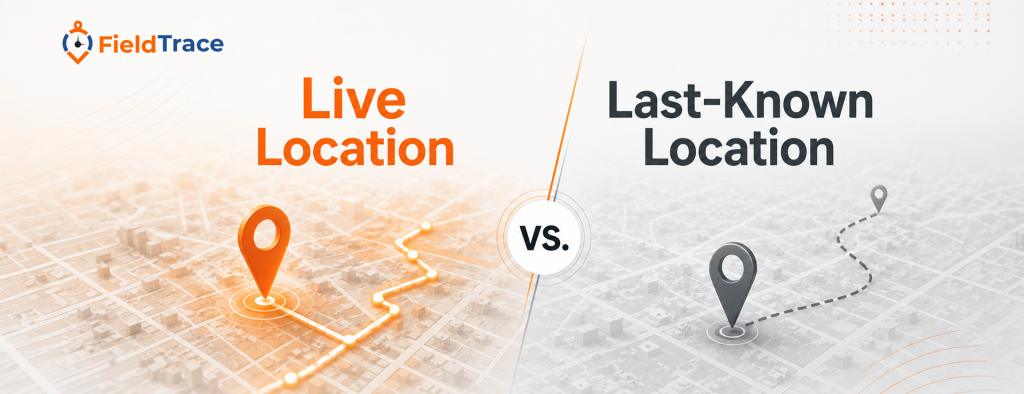
Open your dispatch board and look at any rider on the map. That dot feels like the truth, but it usually isn’t.
It’s a memory, and on most apps it’s several minutes old, which means you’re not running your fleet. You’re running a slightly outdated recording of your fleet, and every decision you make off that recording inherits the delay. That’s the entire difference between real-time location tracking and last-known location: tiny on a screen but expensive on a P&L.
Last-Known Location vs Real-Time Location Tracking: What’s the Difference?
Last-known location is the final GPS point your app managed to upload, whenever that happened to be.
On the other hand, real-time location tracking is a continuous stream where the device reports position every few seconds, so your dashboard shows a live picture instead of a leftover one. Think of it as a photograph versus a video feed. Both are accurate at the moment of capture. Only one tells you what is happening right now.
So, the last known location vs real-time question was never really about GPS accuracy. It’s about freshness, and freshness is the only thing dispatch decisions actually run on.
Why Does Location Lag Happen, And Is It Really the Driver’s Fault?
Three technical realities cause most tracking lag:
- Operating-system battery limits
- Network dead zones
- Blocked satellite signal
Almost none of it begins with a rider trying to disappear.
Start with the OS. Android deliberately throttles apps that fall into the background — official documentation confirms a backgrounded app receives location updates only a few times each hour. A tracking app not engineered around that gets quietly starved of data.
Then connectivity. A rider inside basement parking, a lift shaft, or a patchy stretch of highway can hold a perfect GPS fix with no way to upload it, and without offline buffering that entire segment vanishes.
Finally, the signal itself. GPS.gov notes that smartphones are typically accurate to about 4.9 metres under open sky, and less accurate near buildings, bridges and trees, which describes almost every last-mile route in an Indian city.
So, when a dot freezes on your screen, physics is a likelier culprit than fraud. Blaming the rider is both unfair and useless. What needs fixing is the stack underneath — whether it does true real-time location tracking or just occasional check-ins.
What Does Location Lag Actually Cost a Delivery Operation?
Lag bleeds you in four places:
- Failed first attempts
- Wasted reassignments
- Inbound “where is my order” calls
- Delivery disputes you cannot settle
Run the arithmetic once, and it stops being abstract. A two-wheeler averaging 25 km/h through city traffic covers roughly 4 km in ten minutes. So, a ten-minute-old ping can put your rider four kilometers from where your screen insists he is.
That error compounds in the most expensive part of the chain. Capgemini Research Institute pegs last-mile delivery at around 41% of total supply chain cost, so every re-attempt lands squarely on your thinnest margin.
Customers register it before your ops team does. In Descartes’ 2025 consumer study of 8,000 shoppers, 79% reported a home delivery problem in a single three-month window — and a confidently wrong ETA is one of the quickest ways into that statistic.
None of this appears as a line item called “tracking lag.” It shows up as fuel, overtime, support headcount, and churn, which is why real-time location tracking rarely gets blamed for the damage it causes.
How Does Real-Time GPS Tracking Fix It for Delivery Teams?
Working GPS tracking for delivery staff does three things at once:
- Streams positions continuously
- Buffers and syncs whatever the network swallowed
- Fires geo-fence events the second someone arrives or leaves a drop point
That changes what a manager can do with the map. Real-time delivery tracking lets you reassign an urgent order to the rider who is genuinely closest, not the one whose last ping happened to be flattering.
It also removes the guesswork from customer promises. When field employees’ live location updates every few seconds, your ETA is computed from actual movement, and the support team stops improvising answers.
And it protects the honest rider as much as it exposes the exception. A verified GPS trail settles “he never came” disputes in your favor, and clean real-time location tracking means genuine visits and legitimate expense claims get approved faster.
What to Look for in a Live Location Tracking Software?
Most live location tracking software stops at the dot on the map, which is precisely why so many field apps get abandoned within two months. Judge real-time location tracking on what it does when conditions get ugly, not on how the demo looks.
- Ping frequency and offline buffering — does it keep recording without signal, then sync the gap automatically?
- Geo-fence events — automatic entry and exit stamps at hubs and drop points.
- Verified attendance — GPS plus face confirmation, so shift start is a fact instead of a claim.
- Exception alerts — the system flags the route deviation or long idle stop instead of waiting for you to notice.
- Battery discipline — accuracy that doesn’t kill a phone by 2 pm, or riders will find the off switch.
- Compliance — DPDP, GDPR and ISO certifications, because location data is personal data.
- Depth beyond tracking — orders, tasks and customers connected to the same system of record.
Real-Time Location Tracking with FieldTrace
FieldTrace was built for the gap this whole article describes, so managers act on what is happening rather than what already happened.
Underneath the map sits the part that makes real-time location tracking worth paying for — geo-fenced, face-verified attendance and expense management that produces a tamper-resistant record, plus exception alerts that surface trouble while you can still do something about it.
For delivery and logistics operations, it scales from a 50-rider hub to an enterprise field force without re-platforming, and it carries GDPR, ISO and India DPDP compliance — which usually settles the “is this even legal” conversation before it starts.
Book a FieldTrace demo, and we’ll walk through your actual delivery workflow,
Frequently Asked Questions
What is the difference between live location and last-known location?
Live location streams continuously and shows where a rider is right now, while last-known location is the last point that successfully uploaded, which may be minutes old.
How often should real-time location tracking update?
Every few seconds during active delivery hours, with automatic offline buffering, so no segment is lost when the network drops.
Does live tracking drain a delivery rider’s phone battery?
Well-built apps balance ping frequency against power use, so a full shift should not require a mid-day recharge.
Is GPS tracking for delivery staff legal in India?
Yes, when it is work-scoped, disclosed to employees and handled under DPDP-compliant consent and data-security practices.
Stop Managing Your Field Team on Faith
Geo-fencing, beat planning, alert intelligence, and full customer visibility — one platform that shows you what's really happening on the ground.